
Detect Fraud
Before You Extract.
100+ forensic detectors analyze metadata, fonts, structure, and pixel patterns, catching tampering invisible to the human eye. Hundreds of document signatures. Zero templates to train.
Schedule Demo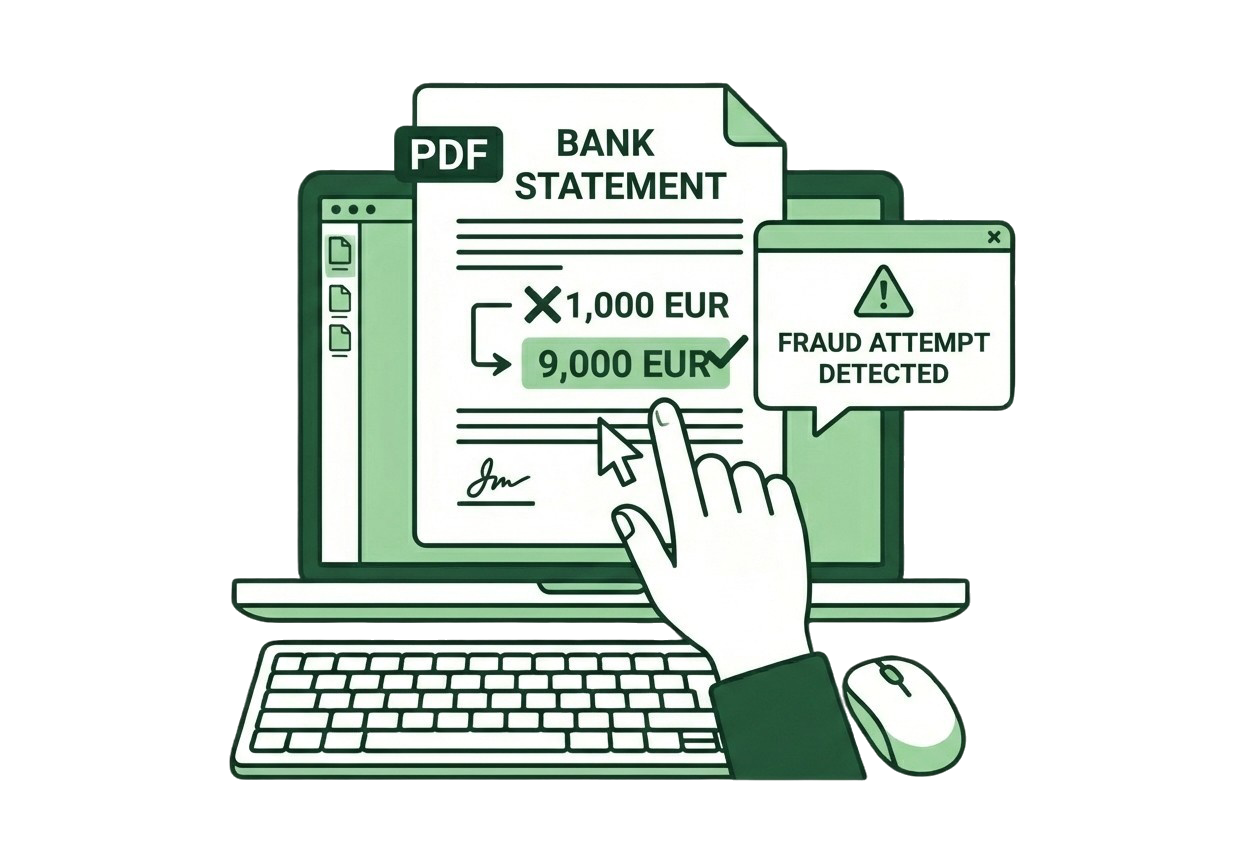
You Can't Extract Data
You Can't Trust.
Document fraud is accelerating. AI makes forgeries easier, and traditional verification can't keep up. The numbers tell the story.
projected U.S. fraud losses from generative AI by 2027.
of financial documents submitted online show signs of fraud or manipulation.
year-over-year increase in digital document forgeries in 2024.
of all document fraud is now digital forgery, surpassing physical counterfeits for the first time.
*1 Deloitte Center for Financial Services. Generative AI could enable $40B in U.S. fraud losses by 2027.
*2 Inscribe, 2026 Document Fraud Report. 1 in 16 financial documents show signs of fraud.
*3 Entrust / Onfido, 2025 Identity Fraud Report. 244% surge in digital document forgeries, 57% of all document fraud now digital.
Inside the PDF.
Every layer, checked.
100+ independent detectors scan across 6 forensic domains. Each detector is deterministic. No LLMs, no hallucinations.
A bank statement that looks right to a reviewer. Under that page, a PDF is a stack of layers, and an edit usually leaves a trace in one of them.
Which tool wrote the file, and how many times it was saved. A page written in a different style from the bank's other pages points to an edit.
Page rewritten by another tool
A digit typed in later often comes from a font, or a cut of a font, that the rest of the statement never uses.
Font forensics
What software reads can differ from what is drawn. Here the page shows 7 250,00 while the text underneath says 1 250,00.
Text matches what is drawn
The original amount can survive in a layer switched off for display, right under the new one.
Hidden layer content
Text can stay in the file but outside the visible page, like a footer cropped out of view.
Text hidden outside the page
The numbers must agree with each other: an IBAN that passes its checksum, transactions dated inside the statement period.
IBAN and date checks
Signals are consolidated into findings, scored across forensic domains, and assigned an actionable verdict.
Verdicts You Can Act On.
Not Scores You Have to Interpret.
Every document gets one of four verdicts, backed by explainable findings. No guesswork, no thresholds to tune.
Trusted
Matches a known institutional document signature. Layout, metadata, and structure are consistent with known authentic templates. Auto-approve with confidence.
Normal
No evidence of modification found. Minor anomalies may exist but are consistent with standard document creation workflows.
Warning
At least one trace worth a human look: a sign of modification or an inconsistency in the file.
High Risk
Strong evidence of manipulation. Content tampering, font splicing, or structural anomalies detected across multiple forensic domains.
Every Document Examined
From Every Angle.
Independent detectors operate across six forensic domains. When multiple domains flag the same document, the verdict carries more weight.
Content Integrity
Verifies that document content hasn't been altered, overlaid, or rewritten after creation.
Typography Forensics
Analyzes fonts, text spacing, and typographic consistency to spot inserted or modified text.
Metadata Analysis
Checks document metadata for signs of tampering, including inconsistent dates and missing properties.
Structural Analysis
Examines internal PDF structure for hidden layers, unusual complexity, or traces of post-creation editing.
Media Forensics
Flags AI-generated imagery, spliced photos, and other signs that embedded images have been fabricated or altered.
Security Analysis
Validates digital signatures, detects embedded scripts, and checks for modifications after signing.
Stronger together: A single anomaly can be noise. When independent domains flag the same document, the verdict reflects that convergence.
Not Just What's Wrong.
What's Right.
Every document receives trust indicators: positive signals that confirm authenticity. When they all pass, you can auto-approve with confidence.
Hundreds of Financial & Institutional Document Signatures
Curated template library, growing continuously
Holofin maintains a curated library of document signatures from hundreds of financial institutions, government agencies, insurers, and corporate issuers. When a document matches a known signature, it earns the highest confidence level: Trusted.
Fraud Detection That Lives Inside
Your Document Pipeline.
Unlike standalone fraud tools, Holofin runs forensic analysis as a native step in your workflow, alongside classification, segmentation, and extraction. One pipeline. One API call.
Received
Analysis
Routing
Verify, then extract
Structural checks run before extraction, so a tampered file can be stopped early. Checks on the figures run once they are read.
One API, full pipeline
No separate vendor for fraud, classification, and extraction. One integration, one response.
Workflow-native routing
Route documents by verdict. Auto-approve trusted. Escalate warnings. Block high-risk.
Built to Check,
Not to Collect.
Holofin's fraud detection examines how a document was built: metadata timestamps, font tables, PDF revision history, image statistics, structural patterns. Where a check needs the figures, such as an IBAN checksum or the dates on a statement, it reads them only to test them against each other.
Sensitive financial data, personal information, and trade secrets remain private.
Fraud detection by document type
Forensic verification tuned to the documents you receive most: payslips, tax notices, bank statements, proof of address and more.

Ready to Secure Your
Document Pipeline?
See how forensic analysis, actionable verdicts, and pipeline integration can protect your operations.